Will my leads know it's AI? How tone of voice training works
By Liam Coyle, Co-founder, SetterFlo·10 min read
Last checked: ·Published:
Some leads may notice, and nobody can promise they won't. Training an AI setter on at least 20 of your real DM conversations makes its replies read much more like you, but it does not make it a person. You can test it in a preview before it goes live, and you can choose whether it tells leads it is an AI. Make that call before you go live.
You have spent years building a way of talking that people trust. Now you are thinking about letting software answer your Instagram DMs in your name, and the obvious worry is what the lead on the other end will make of it.
The short version: training makes the replies sound like you, not like a template, but a lead can still sometimes tell, and you should decide in advance whether the AI says what it is. Below is how the training works and what you can check before anything goes live. Further down are the places it falls short.
We make SetterFlo, so we are describing our own process and we have a reason to make it look good. We have tried to be fair about the downsides, and where we could not confirm a detail we have left it out.
1. Will my leads know it's AI?
Sometimes, yes. It depends on a few things.
- How good the voice training is. A reply that uses your usual phrases, your length and your level of formality is much harder to spot than a generic sales message.
- Whether the lead is paying attention. Someone who has just seen your reel and is excited to hear back rarely stops to analyse the reply. Someone who has been burned by bots before might.
- Whether the AI says what it is. If you switch disclosure on, the question is settled from the first message.
No vendor can honestly promise that leads will never notice, so be wary of any page that does. The more useful question is whether a lead who does notice would feel tricked. That depends on the third point.
2. How does tone of voice training work?
SetterFlo's process is done for you, so the work starts with your existing conversations rather than a settings page.
- You share real DM conversations. We ask for at least 20 of your actual conversations with leads, not templates and not a script you wrote for the purpose.
- We analyse them. We read for your phrases, your energy and how you answer questions and objections, and we build a tone-of-voice profile from that.
- We set up the rest alongside it. That means your qualification criteria, your objection responses, your calendar and your CRM.
- You test it before it goes live. More on that in section 4.
- It goes live. SetterFlo says it goes live about seven days after you pay.
Why at least 20? A voice is a pattern, and a pattern needs enough examples to show up. One or two conversations show what you said to one person on one day. Twenty or more start to show what you say every time.
Watch out for: this only works if your example conversations sound like you. If your past DMs were written by a setter, a VA or from a script, the AI will learn that voice, not yours. Send conversations you wrote yourself, and say so if they were not.
3. What actually gets trained
A voice is more than a tone setting. These are the settings that make it up in the app.
| What | What it covers |
|---|---|
| Tone and personality | Tone, personality, response style and how formal it is |
| Emoji use | How many emojis, and how they are used |
| Your words | Phrases to use, words to avoid and a description of your voice |
| Example messages | Sample messages and DM scripts it should write like |
| Your niche | A description of who you help |
| Objections | The common objections you hear and how you answer them, with switches for price, "need to think", "already have a coach" and "send me info" |
| Pain point triggers | A setting for the pain points it should listen for |
You can also save your voice settings as a named profile before you change anything, and restore it later. A voice that took effort to build is easy to break while experimenting, so a saved profile gives you a way back. The app keeps up to 12 profiles per account.
The saved profile covers your voice, not your business rules. Timing, follow-ups, hand-over to you and your offer details are separate settings and are not rolled back when you restore a voice.
4. The preview and test chat step
This is the part that answers "will it sound like me" better than any description can.
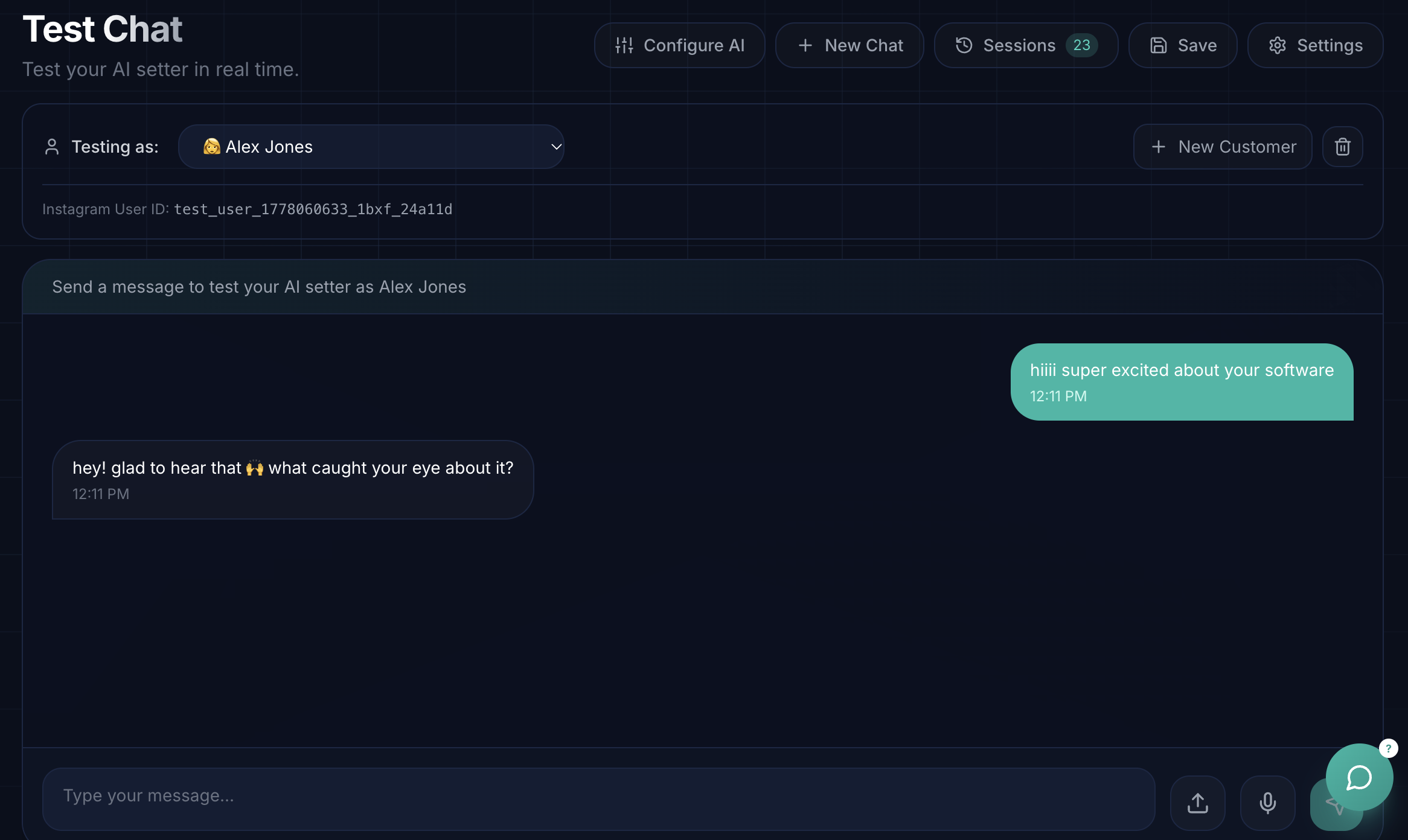
Before the setter talks to real leads, you can try it. SetterFlo's pilot page says you test it in the preview before it goes live. The app also has a Test Chat, where you play the lead. You type a message the way an Instagram follower would, and the AI replies the way it would in a real DM. It is built to simulate the Instagram conversation without needing a live account connection, so you are not testing on a real lead.
Some things worth trying, in this order.
- The ordinary opener. Type what a warm lead would write after your reel. Does the reply sound like something you would send?
- A price question. Ask how much it costs. Is the answer in your words, and does it match what you would actually say?
- An objection. Say "I need to think about it" or "I already have a coach". Compare the reply with how you handle it on a call.
- A direct question about what it is. Type "Is this a bot?" and read the answer carefully. This is the test most people skip, and it is the one that tells you what a real lead would see.
- Something awkward. Mention an injury or a health problem, or send something off topic, and see where it stops and hands the conversation to you.
Each test user is a separate conversation, so you can play different kinds of leads without them mixing. Then edit the voice and test again until you would be happy to have sent the replies.
Watch out for: a test conversation is you playing a lead, and you know exactly how the system works. Real leads are less predictable. Check the first real conversations in your inbox once it is live, and use hand-over to step in when one needs you.
5. Should the AI tell leads it's an AI?
There are two real positions, and both are defensible.
Letting the voice do the work. The AI writes like you and does not volunteer what it is. Some leads will only want a reply and a booking link. The risk is the lead who asks directly, or finds out later and feels misled.
Telling leads up front. With SetterFlo, if you want the AI to identify itself, that is an option. You lose a little of the illusion that you personally typed every message, but you remove the moment where someone feels fooled.
There is no answer here that is right for everyone. A coaching business that sells on trust, such as health or money, has more to lose from a lead who feels deceived than from one who is told. Whichever you choose, run the "Is this a bot?" test above, so you know what a lead will actually be told.
The legal side
This is not legal advice, and you should check your own position with a solicitor. The EU's AI Act includes a transparency rule, Article 50(1), that applies from 2 August 2026. According to the European Commission's guidance, it requires that people are informed they are interacting with an AI system, unless that is obvious to an average, reasonably well-informed person. The Commission says the exception should be read restrictively. The duty is put on the provider of the AI system, and the rules in this area differ by country and are still being interpreted.
What that means for a coach who sells to people in the EU is a question for a lawyer, not for a blog post. As a practical matter, an AI that tells leads what it is, from the first message, is a simpler position to defend than one that does not. For the separate question of whether Instagram itself allows this, see our guide on whether Instagram DM automation is safe.
6. The honest limits
Voice training has limits, and you should know them before you pay.
- It copies how you write, not what you know. The AI learns your phrasing and energy. It does not have your judgement about when to push, when to wait and when to let a lead go.
- Leads may still notice. Fast replies at any hour, a consistent length and a tone that never has a bad day can be clues in themselves. Training narrows the gap but does not close it.
- It hands back what it should not answer. SetterFlo is built to hand the conversation to you when it should not be the one replying, for example when a lead mentions a health condition. You can also take over any conversation yourself. That means you will still get some messages that need a person.
- It is only as good as the examples. Fewer than 20 real conversations, or conversations that were not yours, give it less to learn from.
- It does not replace your calls. It qualifies leads and books the call. The sale itself still happens with you or your closer. For how to handle what comes up before the call, see handling Instagram DM objections.
- It is Instagram only and works in English and Spanish. If you sell on WhatsApp or in another language, check the comparison of AI appointment setters for tools that cover those.
If you already have a human setter, our page on SetterFlo against a human setter sets out where each is stronger.
7. Is it worth it for you?
It is worth a look if you have a pile of real DM conversations in your own voice and you are slow to reply because you are on calls. You also need to be comfortable deciding how openly the AI describes itself. The pilot, which includes the preview step, is described on the pilot page.
It is a poorer fit if someone else writes your DMs, or if you want a promise that no lead will ever know.
Questions
Will my leads know it's AI?
Some may. Training on at least 20 of your real DM conversations makes the replies sound like you, but nobody can promise a lead will never notice. If you want to remove the doubt, you can choose to have the AI say it is an AI.
How many conversations does the AI need to learn my tone of voice?
SetterFlo's process uses at least 20 of your real DM conversations. They should be conversations you wrote yourself, because the AI learns whatever voice is in them. We analyse them for your phrases, your energy and how you handle objections.
Can I test the AI before it talks to real leads?
Yes. SetterFlo's pilot page says you test it in a preview before it goes live, and the app has a Test Chat where you play the lead. Nothing in a test reaches a real lead. Try an opener, a price question, an objection and "Is this a bot?".
Can the AI tell leads that it is an AI?
SetterFlo's site says that if you want the AI to identify itself, that is an option. It is your choice. Whichever you pick, test what it says when a lead asks directly.
Do I have to tell people my Instagram DMs are answered by AI?
It depends on where your leads are and on the rules that apply to you, and this is not legal advice. The EU AI Act has a rule, Article 50(1), that applies from 2 August 2026 and generally requires people to be told they are interacting with an AI unless that is obvious. Ask a solicitor about your own case.
What if I don't like how the AI sounds?
Change the voice settings and test again before anything goes live. You can also save your current voice as a named profile before you experiment, then restore it if the change makes things worse.
What does the AI do when it should not answer?
SetterFlo hands the conversation back to you when it should not be the one replying, for example when a lead mentions a health condition. You can also take over any conversation yourself at any point.
Apply for the SetterFlo pilot
10 places, 4 left. $997 setup includes the first three months, then $297 a month.
Apply for PilotRelated guides
- What is an AI appointment setter, and how does it work on Instagram?
An AI appointment setter answers your Instagram DMs, qualifies leads and books calls. How it works, what Meta allows, where it falls short, and who it suits.
- Is Instagram DM automation safe? Meta's API, bans and GDPR
What Meta's official API allows, why a tool that asks for your password is different, and what GDPR means for your leads' messages.
- Your Instagram setter just quit: a 7-day plan to keep your DMs covered
Your setter just quit. A day-by-day plan to lock down access, answer waiting leads, rescue booked calls and decide between rehiring, AI or doing it yourself.